Classroom Notes: 1.3 Selection
Selection and Selection Statements (Concept Based)
1) What is the main purpose of selection in programming?
Selection is a programming concept that allows algorithms and programs to make decisions and determine what to do next based on the outcome of a condition (True or False).
2) What are the components of a selection statement?
A selection statement has three parts:
- Condition: The question to check (e.g., Is it raining?)
- True path (THEN BLOCK): What to do if the condition is “TRUE”
- False path (ELSE BLOCK): What to do if the condition is “FALSE”
3) What is a basic IF Statement?
A Basic IF statement checks a condition:
Basic IF example: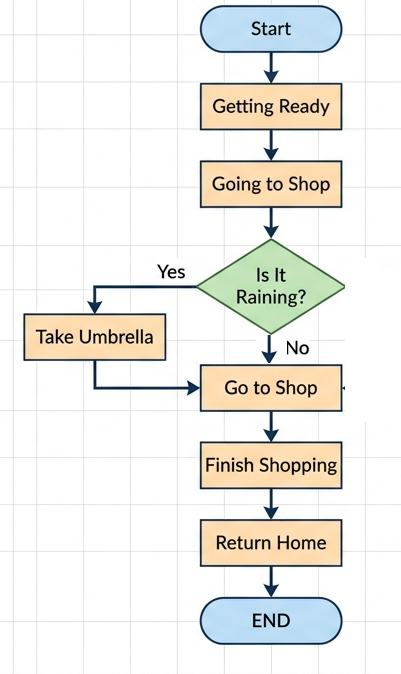
- If the condition is TRUE, it executes the instructions underneath the THEN block.
- If the condition is FALSE, it ignores the instructions under the IF block and continues with the normal sequence.
Basic IF example:
4) Explain IF THEN ELSE Statement?
An IF–THEN–ELSE statement is like a decision map for a computer based on condition:
After branching: The program rejoins the main sequence and continues running.
- IF → the condition is TRUE: The instructions in the THEN BLOCK are executed.
- IF → the condition is FALSE: The instructions in the ELSE BLOCK are executed.
After branching: The program rejoins the main sequence and continues running.
5) What happens in a basic IF statement when the condition is False?
If the condition evaluates to False, the program completely ignores the instructions directly under the IF statement. It simply moves forward and continues running the rest of the algorithm in its normal sequence.
6) How does an IF THEN ELSE statement differ from a basic IF statement?
A basic IF statement only gives instructions for when a condition is TRUE, skipping them if FALSE.
An IF THEN ELSE statement provides two separate outcomes based on the condition:
An IF THEN ELSE statement provides two separate outcomes based on the condition:
- TRUE Path: If the condition is TRUE, executes instructions in the THEN block.
- FALSE Path: If the condition is FALSE, executes instructions in the ELSE block.
7) What are the two condition blocks in Scratch?
The two condition blocks in Scratch are:
- IF THEN
- IF THEN ELSE
8) Code Analysis: Which message is spoken regardless of whether the condition is True or False?
Look at the following code:
IF Time equal to morning
THEN Say "Good morning"
ELSE
Say "Good afternoon"
Say "How are you?"
Answer: The message "How are you?" will always be spoken. Because it is NOT part of the IF THEN ELSE block, the algorithm executes it in the normal sequence after completing the selection branch.
Second Order Thinking Skills Questions
9) Analyzing Trace Tables and Score Accumulation
A student plays a scoring game with the following two rounds:
Round One:
Answer:
Round One:
1 set PlayerScore to 0
2 IF ShirtColour equal to Red
3 THEN set PlayerScore to PlayerScore + 2
4 ELSE
5 set PlayerScore to PlayerScore + 1
Round Two:
1 IF ShoeSize equal to 18
2 THEN set PlayerScore to PlayerScore + 1
3 ELSE
4 set PlayerScore to PlayerScore + 2
Question: Analyze the score outcome for a student wearing a Blue shirt with a shoe size of 18 at the end of each Round.
Answer:
- Round One Execution: 1 (Condition 'ShirtColour equal to Red' is FALSE → Else branch adds 1 → Score = 1)
- Round Two Execution: 2 (Condition 'ShoeSize equal to 18' is TRUE → Then branch adds 1 → Final Score = 2)